

SpaceX stock fell as much as 11% on Wednesday after record AI investment, and an approaching share unlock overshadowed the company’s stronger-than-expected second-quarter revenue.
Summary
- SpaceX generated $7.8 billion in Q2 revenue, up 92% from a year earlier.
- AI-related capital expenditure jumped to $15.8 billion, compared with $749 million a year ago.
- Piper Sandler cut its SPCX price target to $140 from $156 while retaining a Neutral rating.
- SPCX faces further pressure as its tradable share count could rise by more than 140%.
SpaceX revenue beats Wall Street estimates
SpaceX reported $7.8 billion in second-quarter revenue, exceeding Wall Street’s estimate of about $6.8 billion. Revenue rose 92% from $4.1 billion in the same period last year, marking a strong first earnings report since the company’s June Nasdaq debut.
Starlink remained the company’s main financial engine. Revenue from the satellite connectivity business rose 66%, while SpaceX’s AI revenue increased by about 250% from a year earlier. The company’s total operating loss narrowed to $143 million from $970 million, according to Reuters.
However, investors focused on how much SpaceX spent to generate that growth. Total quarterly capital expenditure climbed above $18 billion, including $15.83 billion allocated to AI infrastructure. That compared with only $749 million in AI spending during the year-ago period.
Finance chief Bret Johnsen said capital spending would likely remain near current levels over the next several quarters. The outlook raised questions about how long Starlink may need to fund the company’s AI and space-development plans.
AI spending overshadows SpaceX earnings beat
SpaceX is expanding its computing capacity as Elon Musk positions AI as a major part of the company’s future valuation. AI revenue reached roughly $2.6 billion during the quarter, supported by new cloud-computing contracts.
Still, the amount committed to AI infrastructure exceeded market forecasts. At $15.8 billion, AI capital spending more than doubled from $7.7 billion in the first quarter and accounted for most of SpaceX’s total investment during Q2.
The spending contributed to a sharp change in sentiment after the results. SPCX initially fell 7.5% in after-hours trading before extending its decline to more than 11% in Wednesday’s pre-market session. The drop came despite a positive session for broader US equity futures, suggesting that company-specific concerns drove the move.
SpaceX also reported a net loss of $541 million, although adjusted earnings before interest, taxes, depreciation and amortization nearly tripled to $3.5 billion, according to Fortune.
Analysts remain divided on SPCX stock
Piper Sandler lowered its SpaceX price target from $156 to $140 while maintaining a Neutral rating. The brokerage raised its earnings forecasts but cited valuation pressure, uncertain AI cloud contract durability and higher anticipated spending.
The firm now expects fiscal 2027 capital expenditure of about $65 billion, roughly $17 billion above its previous projection. It also warned that the number of tradable SPCX shares could soon increase by more than 140%, creating a potential supply overhang.
Other Wall Street firms retained more bullish forecasts. Bank of America reaffirmed its Buy rating and $235 target, while JPMorgan raised its target from $225 to $240. Mizuho maintained a positive rating and a $200 target.
These forecasts indicate that analysts remain constructive on SpaceX’s long-term business despite concerns about near-term spending and dilution.
SPCX chart puts $104.91 support in focus
SPCX traded at $114.93 on the four-hour chart, down 8.66% during the session after touching an intraday low of $109.21. The stock’s attempted rebound was rejected near $126, returning it below the 78.6% Fibonacci retracement at $119.34.
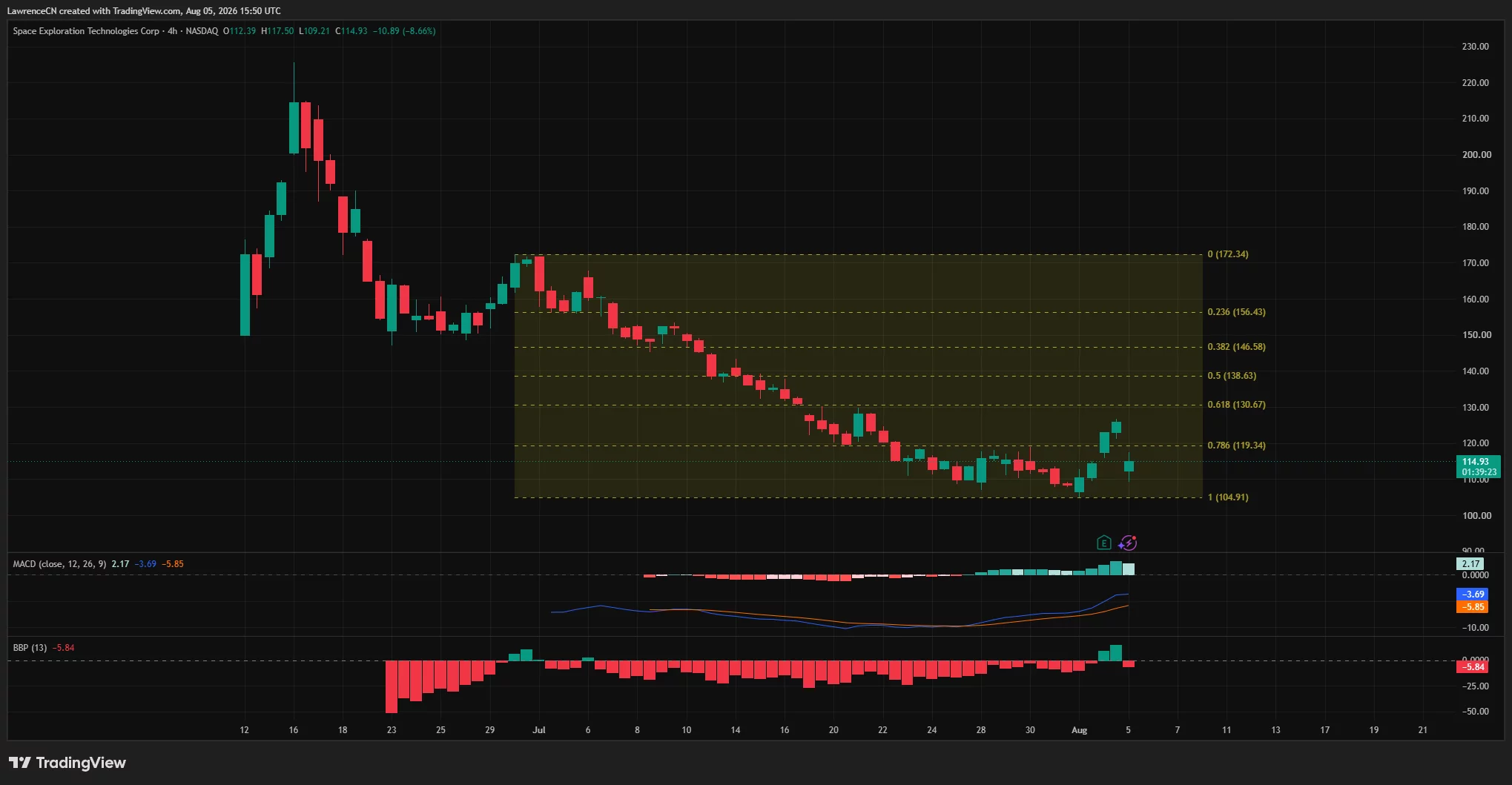
A sustained recovery above $119.34 could allow buyers to target $130.67. Further resistance stands at $138.63 and $146.58, but the broader trend remains weak following the decline from $172.34 in early July.
On the downside, $109 is the first area to watch. A break below that level would expose the July low at $104.91 and deepen the stock’s drop below its $135 IPO price.
The MACD shows that bearish momentum has eased from its July peak, but the latest rejection and negative Bull-Bear Power reading indicate that sellers remain active. Thursday’s post-IPO share unlock could add another source of volatility for US investors.