

Key Takeaways
- A U.S. de minimis exemption for small bitcoin and crypto payments could generate up to $2.58 billion in net revenue over 10 years.
- Removing capital gains reporting burdens could encourage more people to spend bitcoin on everyday purchases.
- A de minimis exemption could strengthen bitcoin adoption and, potentially, support bitcoin price over the longer term.
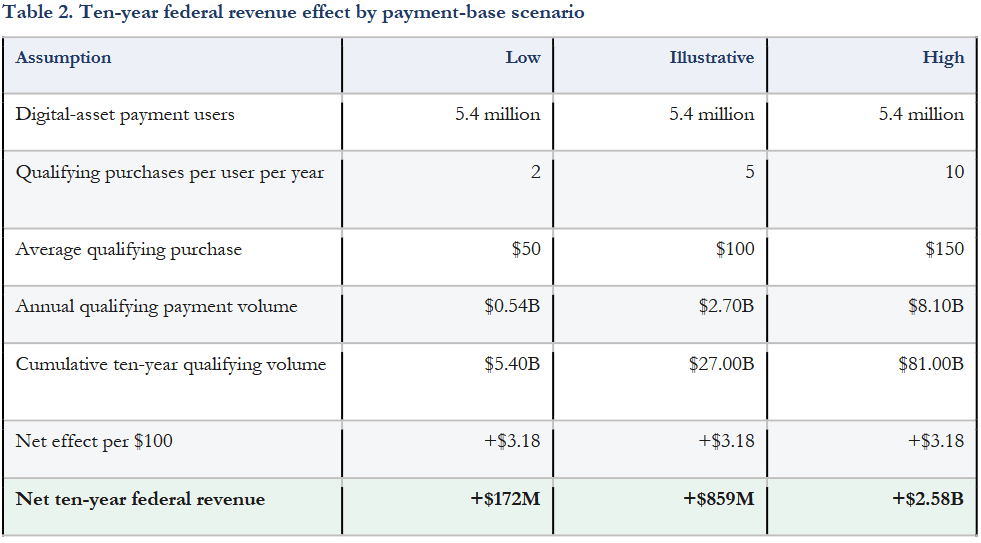
The report examined how the so-called de minimis exemption on bitcoin and other crypto asset payments, currently under discussion among U.S. lawmakers, could affect federal revenue. It found a possible 10-year net revenue gain of approximately $859 million. This is the central scenario, while the estimates range between $172 million and $2.58 billion, depending on different scenarios detailed below.
The estimates come with various caveats, including the assumption that the current base of 5.4 million digital-asset payment users won’t change over the next decade, according to the Cornell Brooks School Tech Policy Institute (BTPI). The 5.4 million figure is based on Kansas City Fed estimates from 2024.
If approved, the bill that suggests this relief, S. 2207, introduced by Sen. Cynthia Lummis, would exempt bitcoin and crypto purchases under $300 from capital gains tax, capped at $5,000 in excluded gains per year. However, there are also other legislative initiatives that would limit the relief to regulated stablecoins only, but the fight is still ongoing.
Challenges of Taxing and Spending
BTPI, which cooperates with the Bitcoin Policy Institute on a separate study, says that, according to the U.S. Internal Revenue Service (IRS), only 32%-56% of U.S. crypto asset holders report gains, while the current tax system, which taxes all BTC and crypto payments, discourages people from spending.
This is happening both because of the capital gains tax and because of the complicated process of reporting these gains when making many small, everyday purchases. For example, in April this year, crypto exchange Kraken said that it had issued more than 56 million tax forms required for reporting digital asset transactions to the IRS. The company noted that almost a third of those forms were for transactions worth less than $1, while more than half were for $10 or less, and three out of every four were for less than $50.
“The U.S. is an outlier in this respect. The UK, for instance, applies an annual capital gains allowance that effectively exempts small crypto transactions such as this from reporting. A targeted de minimis threshold wouldn’t be novel. It would just catch America up,” Kraken said back in April.
Cornell’s estimate, which covers the exemption on small payments only, is much higher than that of the Joint Committee on Taxation, which serves as Congress’s tax scorekeeper. The latter estimates that S. 2207 would help generate around $600 million over 10 years. However, this number covers the effect of the whole bill, which also addresses the tax treatment of digital-asset lending, charitable contributions, and mining and staking income, in addition to payments.
More Incentives to Pay With Bitcoin
Therefore, given the current tax and reporting burden, a de minimis exemption might encourage extra spending, increasing economic activity and, in turn, government revenue.
“Because the direct revenue loss from the exemption is relatively small, only a modest amount of genuinely new spending is needed to offset it. If qualifying payment volume doubles, the provision breaks even when roughly 10 percent of the increase represents new purchases,” the BPTI report said, adding that every dollar of additional taxable activity generates roughly 16 cents in federal receipts.
According to the institute, if the transaction-specific tax and reporting burden are removed, holders may become more willing to realize appreciated assets. They may also change both whether they make a purchase and which payment method they use.
How It Might Help Bitcoin Price
Now, considering that Cornell is right and that the de minimis exemption is indeed approved, this could also result in a “collateral gain.” In other words, removing the extra costs and headache of paying with bitcoin might not only encourage existing holders to spend their satoshis, but could also increase demand for bitcoin as a payment method.
Subsequently, this might affect its price and help governments collect more capital gains-related taxes from larger bitcoin payments and/or sales. However, at the current level of bitcoin payment adoption, this might look better in theory than in practice. The effect is likely to be negligible both on the price and tax revenues in the near to medium term, but the situation might be considerably different in the longer term.
For example, while stablecoins are gaining ground in the payments industry, bitcoin can still be superior when it comes to more private, safer, cheaper, faster, and more censorship-resistant payments. Moreover, none of the existing major stablecoins, at least, is a truly global payment method because each of these tokens is a liability of its operator, operating within a specific jurisdiction and deeply embedded in the existing financial system, while BTC is outside all of this.
What’s more, both the industry and regulators across jurisdictions will need to determine how to tax bitcoin transactions in the agentic economy, which is likely to be dominated by microtransactions and would increase economic activity further.
Tax Is Only Part of the Bigger Picture
In either case, an exemption from capital gains tax on small purchases is only one of the things that could encourage BTC spending and increase its demand. Spending occasions, price volatility, people’s habits, and payment rail positioning, among other things, also affect whether even a bitcoin maxi will pay in BTC or a stablecoin.
The effect on bitcoin demand and its price would also depend on whether BTC-accepting merchants still mostly sell the bitcoin they collect or keep it, possibly helping build a circular economy.
In either case, while the exact effect of the de minimis exemption on the demand for bitcoin as a medium of exchange remains unknown, it could become one of many things that could potentially help strengthen bitcoin adoption. In turn, long-term, this could help make bitcoin price less dependent on external factors such as macroeconomics, geopolitics, and pure speculation, which are now the key drivers of its price.
Global Opportunities
Meanwhile, while BTPI focused on the U.S. only, de minimis exemptions might become an economic boost in other countries as well. Moreover, many other major economies tax spending more heavily through value-added tax than the U.S., meaning that every extra spent euro, pound, krona, or yen would generate even more revenue.
Also, as reported by Bitcoin.com News, this month, finance ministers and central bank governors from G20 countries recognized “the transformative role” of digital assets in supporting broad-based economic growth.
Therefore, if BTPI is right, de minimis exemptions might support economies all over the world, as BTC holders would be encouraged to spend their sats more, cementing bitcoin’s role as money, among other things, and increasing demand further. Bitcoin price will follow.