The common financial milestone for the typical Filipino family used to be simple: park your hard-earned money in a savings bank, and sleep soundly knowing your capital is safe.
This is the classic pag-iipon mindset where we prioritize capital preservation above all else.
In recent years, tech-savvy savers migrated to high-yield digital banks offering attractive 3.5% to 6% interest rates to fight off inflation. Yet, even with digital banking shaking up the landscape, savers still face subtle catch-22s: traditional bank interest rates fail to outpace inflation, while digital banks often hook depositors with high introductory yields only to eventually lower their APYs, thus leaving returns floating, capped, or tied to gamified spending “missions.”
Fortunately, the digital asset landscape has evolved. Thanks to blockchain technology and tokenization, everyday retail investors can now bypass traditional gatekeepers and access high-security, government-backed alternatives that were once reserved only for the wealthy.
The Search for Safety: Traditional Filipino Savings Habits
Filipino culture inherently values financial peace of mind. We love tangible safety, which is why passbook savings accounts, time deposits, and physical cash storage (alkansya) remain deeply ingrained in our financial habits.
For the average saver, risking money in the volatile stock market or complex investment vehicles feels like gambling. Capital preservation is the golden rule. Knowing that your ₱10,000 will still be ₱10,000 next year brings a sense of security.
However, this traditional approach overlooks a wealth-killer: inflation.
- If your money sits in a traditional bank account giving you a meager 0.0625% to 1% annual interest, while inflation runs at 4% to 5%, your “safe” money is actively shrinking in purchasing power.
- High-yield digital banks offer a better shield against inflation, but their top rates are frequently floating, temporary promotional offers, or capped at specific amounts (e.g., only applying to the first ₱100,000).
The Hidden Barriers of Traditional Fixed-Income Investing
If you want low-risk, steady returns backed by the government, bonds like Treasury Bills (T-Bills) and Retail Treasury Bonds (RTBs) are the gold standard. Because the government itself guarantees them, they remain virtually risk-free.
Yet, historically, everyday retail investors in the Philippines have been locked out of this market due to several steep barriers:
- Traditional banks usually require a minimum investment ranging from ₱5,000 to ₱500,000 to access primary bond offerings. Additionally, these were previously only available through bank walk-ins and required accomplishing multiple forms just to buy one bond, which takes a lot of time. This creates an immediate dealbreaker for the average daily wage earner.
- Getting into fixed-income securities traditionally means physically visiting a bank branch, filling out stacks of physical forms, and navigating confusing bureaucratic red tape.
- If you need your money back before the bond matures, the process of selling it on the secondary market via a bank is cumbersome and often penalized with heavy fees.
- The traditional bond market is heavily skewed toward ultra-high-net-worth individuals, corporations, and massive institutional funds, leaving retail savers with the crumbs.
PDAX Tokenized Bonds: An Institutional-Grade Alternative
This is where blockchain steps in to level the playing field.
Longtime BitPinas readers recognize PDAX, a BSP-supervised crypto platform. But the company, through its subsidiary PDAX Securities (formerly bonds.ph Inc.), also operates as a licensed Government Securities Eligible Dealer (GSED). This unique position allows them to bridge the gap between traditional state-backed debt and modern digital infrastructure.
By leveraging tokenization, PDAX breaks down these massive, institutional-grade government bonds into tiny, fractionalized digital tokens.
What is Tokenization? In simple terms, it takes a real-world financial asset (like a million-peso government bond) and cuts it into affordable, digital micro-shares on the blockchain.
This means you get the exact same sovereign backing and safety as a multi-millionaire investor, but with full retail accessibility.
Traditional Savings Accounts vs. PDAX Tokenized Bonds
To see which financial vehicle acts as a smarter hedge for your wealth, let’s look at how traditional savings stack up directly against PDAX’s tokenized offerings:
(to become infographic as well):
| Feature | Traditional Savings & High-Yield Digital Banks | PDAX Tokenized Bonds |
| Yield Basis | Traditional: Low fixed interest (0.1% to 2%). Digital: Higher yields (3.5% to 6%) but often floating, promotional, or capped. |
Competitive, fixed government-backed coupon rates lock in your yield for the entire term, completely unaffected by market shifts. |
| Minimum Entry | Traditional: High minimums for premium time deposits (₱10,000+). Digital: Low entry, but peak rates often require specific spending goals. |
Democratized low entry point, allowing you to start investing for as low as ₱500. |
| Liquidity | Traditional: Strict branch hours and time deposit penalties. Digital: High app liquidity, though subject to withdrawal fees or daily limits. |
24/7 digital management via the mobile app, allowing users to track performance or buy and sell on the secondary market anytime. |
| Security | Protected by PDIC insurance up to a maximum limit of ₱1,000,000 per depositor. | Direct sovereign backing by the Republic of the Philippines (virtually zero default risk). |
| Divisibility | Rigid, fixed terms where you cannot easily peel off a small fraction of your investment. | Flexible fractional allocations; buy and scale your portfolio in increments that suit your budget. |
| Payout Structure | Interest is usually distributed only at maturity or on strict monthly bank schedules. | Predictable cash flow via quarterly coupon payouts (for RTBs) or upfront capital discounts (for T-Bills). |
Practical Use Cases
Who actually benefits from swapping their traditional savings mindset for tokenized bonds? Here are a few real-world scenarios:
- OFWs: Instead of sending money home to sit in a low-interest savings account or exposing it to the fluctuating promotional rates of digital banks, an OFW can use PDAX to consistently build a secure, interest-bearing fund. Because the entry barrier is only ₱500, they can seamlessly allocate small portions of every payday toward low-risk government debt from abroad.
- Crypto Holders: Crypto markets are notoriously volatile. When the market turns bearish or a trader wants to take profits after a massive bull run, they need a safe haven. They can park their profits directly into tokenized bonds inside the app to earn steady, low-risk yields while waiting for the next market cycle.
- Savers: Whether you are saving for a wedding, a down payment on a house, or a child’s college fund, inflation is your biggest enemy. Unlike digital banks that might lower their interest rates next month, tokenized bonds allow milestone savers to lock in a guaranteed rate for years, ensuring their capital grows predictably without erosion from rising consumer prices.
Important Considerations
While tokenized bonds are an incredible financial tool, smart investing requires managing your expectations and understanding the mechanics:
- This is a digital security. To manage your investments, buy more tokens, or track your yields, you will need consistent smartphone and internet access, alongside a fully verified PDAX account.
- Even though tokenization increases accessibility, these are still fixed-income instruments. Government bonds have specific maturity dates (e.g., 91 days, 1 year, or 3 years). While secondary market liquidity exists within the app, selling your bonds before their official maturity date depends on market demand and can fluctuate slightly in value.
Step-by-Step: How to Invest in Treasury Bonds on PDAX
Ready to transition from passive saver to strategic investor? Here is how to get started inside the PDAX app:
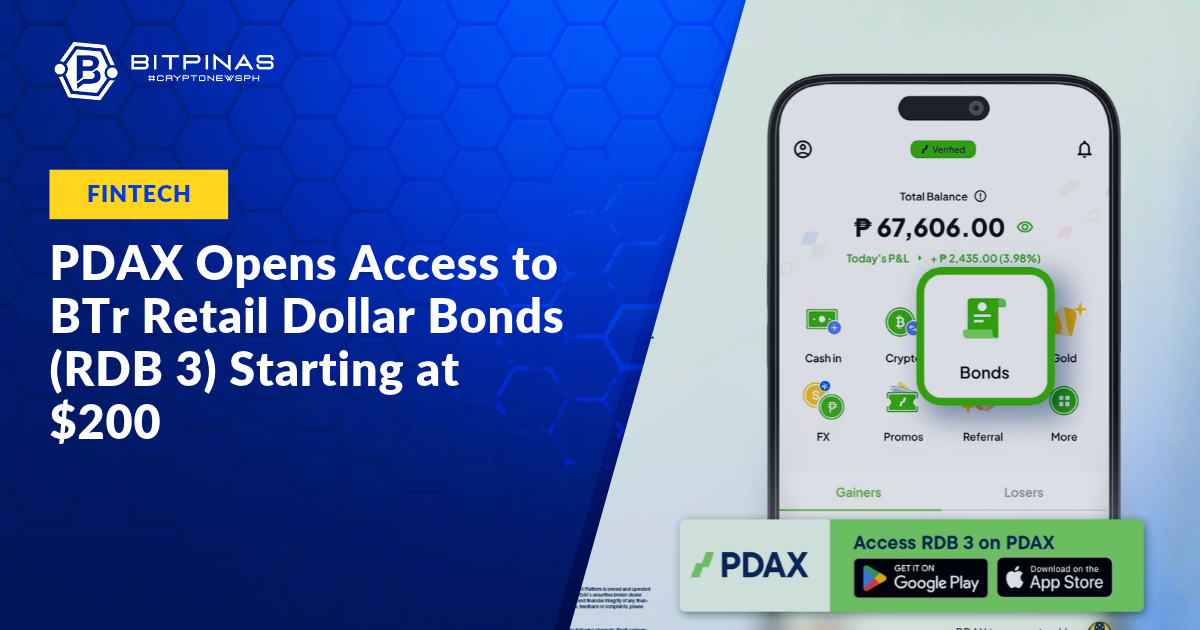
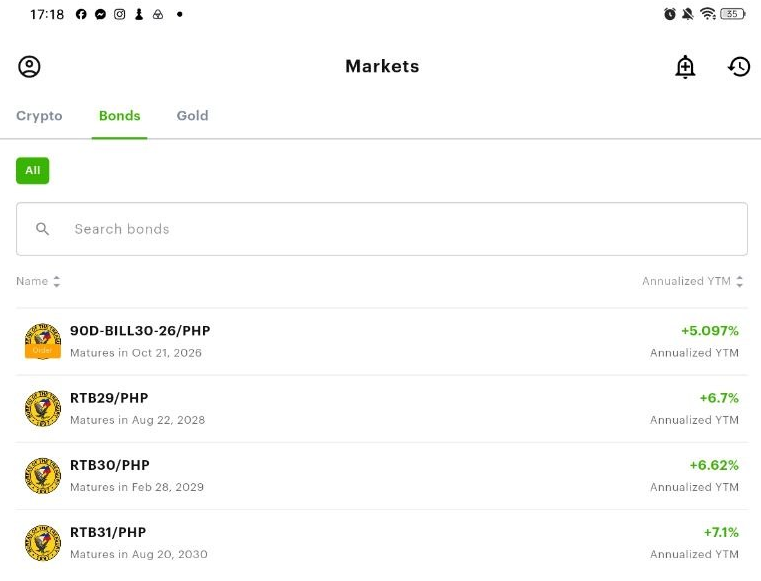
- Open your verified PDAX app and log in. On the main dashboard, look for and tap the “Bonds” icon to access the fixed-income marketplace.
- Browse through the available offerings. You can choose between short-term T-Bills (which offer upfront discounts) or longer-term RTBs (which distribute regular quarterly coupon payments).
- Enter the amount you wish to invest. Remember, you can start with a minimum of just ₱500 for T-Bills and ₱5000 for RTBs. Review the terms, yield rate, and maturity date, then confirm the transaction.
- Once purchased, your tokenized bonds will reflect in your digital portfolio. You can track your maturity timelines, upcoming coupon payout dates, and accrued interest directly from your phone 24/7.
Closing Thoughts
Traditional bank accounts offer comfort through familiarity, and digital banks provide modern convenience with competitive, short-term yields. However, neither gives you the ultimate combination of guaranteed fixed returns and absolute, state-backed protection.
PDAX Tokenized Bonds effectively solve this.
If your goal is to protect your capital from inflation without taking on corporate bank risk or market volatility, it’s time to add tokenized bonds to your portfolio.
This article is published on BitPinas: Looking For Steadier Returns? Explore Government Bonds on PDAX
What else is happening in Crypto Philippines and beyond: