
Why is crypto crashing? Bitcoin has fallen below $69,000, dragging Ethereum and major altcoins into a market selloff. Investors are facing a combination of worsening macroeconomic conditions, shrinking liquidity, and billions of dollars in forced liquidations.
The decline is not happening in isolation. US inflation data has revived expectations of another Federal Reserve rate hike, while technology stocks face fresh uncertainty following Nvidia’s leadership shake-up. But it’s not Satoshi that cheats, so why is crypto crashing?
Institutional investors are withdrawing money from Bitcoin ETFs, and stablecoin supply is contracting. Here are five reasons why crypto is crashing and what is making this decline particularly difficult to reverse.
1. Inflation Is Bringing Back Federal Reserve Rate Hike Fears
The latest US inflation figures have complicated the outlook for financial markets. October’s hotter-than-expected consumer inflation readings pushed investors to reconsider the Federal Reserve’s next move.
BREAKING: October CPI inflation rises +0.4% month-over-month, above expectations of +0.3%.
Core CPI inflation rose +0.3%, also above expectations of +0.2%.
BLS will not be releasing year-over-year figures due to the October 2025 government shutdown.
Inflation still appears to…
— The Kobeissi Letter (@KobeissiLetter) November 10, 2026
Markets are increasingly concerned that policymakers could raise interest rates in December rather than deliver the relief risk assets were expecting. Higher interest rates generally make speculative investments less attractive. Bitcoin and altcoins have historically struggled when investors anticipate tighter financial conditions.
The US dollar has also strengthened, adding another headwind for the crypto market.
2. Nvidia’s Leadership Shock Is Spooking Risk Markets
Crypto is increasingly sensitive to developments in traditional technology markets. Nvidia’s leadership shake-up has added another source of uncertainty for investors already questioning expensive AI-related valuations.
Bitcoin fell alongside technology stocks as investors reduced exposure to riskier assets. This matters because crypto has increasingly traded like high-beta technology investments during periods of market stress.
When investors start selling speculative technology stocks, Bitcoin can quickly become another source of liquidity.
DISCOVER: 15+ Upcoming Coinbase Listings to Watch in 2026
3. Stablecoin Supply Is Shrinking by $14.2 Billion
One of the most concerning developments is happening inside crypto itself. Glassnode reported that major stablecoin supply contracted by $14.2 billion over 30 days. This marked the largest contraction since the 2022 bear market.
Total stablecoin supply slipped below $280 billion as capital left the crypto ecosystem rather than simply rotating between tokens. Stablecoins function as crypto’s cash reserves. Traders use USDT and USDC to purchase Bitcoin, enter altcoin positions, and provide liquidity across exchanges.
Tether supply is shrinking faster than it did after FTX.
USDT market cap is down $6.6B in 60 days, more than double the December 2022 drop.
Stablecoin growth funded every rally this cycle. That fuel is draining. pic.twitter.com/WxQNDdwZER
— CryptoQuant.com (@cryptoquant_com) November 10, 2026
When stablecoin supply contracts, fewer dollars remain available to support another market recovery.
4. Bitcoin and Ethereum ETF Investors Are Pulling Their Money
Institutional demand is weakening as US spot Bitcoin ETFs record six consecutive trading sessions of net outflows through November 12.
The funds lost $47.7 million on November 12, bringing cumulative withdrawals across the six sessions since November 5 to roughly $1.49 billion. Ethereum ETFs recorded another $8 million in net outflows on November 12, bringing combined daily withdrawals across both asset classes to $55.7 million.
BlackRock’s IBIT had dominated earlier Bitcoin ETF withdrawals, losing $269.7 million on November 11 alone. However, the latest session showed a smaller overall outflow, suggesting selling pressure had eased.
This remains concerning because spot ETFs have become one of Bitcoin’s biggest institutional demand channels. Persistent withdrawals remove an important source of buying pressure, particularly when retail investors are already reluctant to enter during a downturn.
DISCOVER: 15+ Best Crypto IPO to Watch in 2026
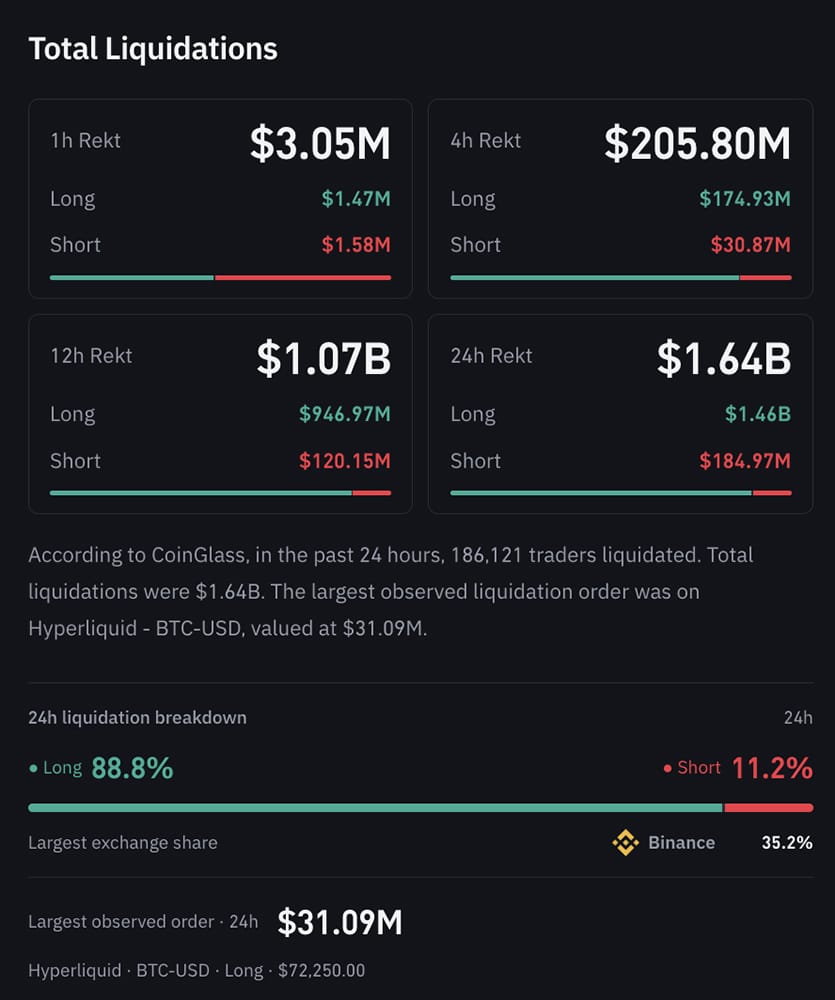
5. The Final Nail in the Coffin: More Than $1.4 Billion in Crypto Positions Were Liquidated
The final ingredient is leverage.
CoinGlass data showed $1.64 billion in crypto liquidations over 24 hours. Long positions accounted for $1.31 billion, meaning bullish traders suffered most of the damage. Bitcoin’s break below $70,000 accelerated the process. Traders using borrowed capital suddenly faced liquidation thresholds, forcing exchanges to close their positions.

Those forced sales pushed prices lower, triggering additional liquidations across the market. This creates a dangerous feedback loop. Falling prices eliminate leveraged buyers, while forced selling makes it harder for Bitcoin to stabilize.
We Know Why Crypto Is Crashing, But Can Bitcoin Recover From the Crypto Crash?
Bitcoin needs more than a temporary bounce to reverse the current decline. The first improvement would be renewed stablecoin supply growth. Fresh capital needs to return to the crypto markets.
ETF flows also need to turn positive again. Consistent institutional withdrawals make it difficult for Bitcoin to sustain a meaningful recovery. Finally, we need to see liquidation pressure ease without another breakdown in spot demand.
The current selloff combines macroeconomic pressure with a genuine contraction in crypto liquidity. That makes this more complicated than an ordinary leveraged correction.
Follow 99Bitcoins on X For the Latest Market Updates, and Subscribe on YouTube For Daily Expert Market Analysis.
The post Why Is Crypto Crashing? 5 Reasons Bitcoin and Altcoins Are Suddenly Falling appeared first on 99Bitcoins.