






Key Takeaways:
- TRM Labs reports a Q1 2026 shift to USDT, boosting Venezuela’s volume to $17.9B for future savings.
- Binance P2P data shows 90.2% of listings feature USDT-VES pairs.
- Economists have proposed a national stablecoin to fix market instability and currency controls.
TRM Labs Puts Venezuelan Stablecoin Use Case in the Spotlight
Stablecoins have taken the cryptocurrency world by storm, becoming an essential tool for economies battling episodes of high inflation and high devaluation.
TRM Labs, a blockchain intelligence company, highlighted the relevance stablecoins reached in Venezuela. In its Q1 2026 Global Crypto Adoption Index, the organization puts this subject in the spotlight, stressing that since their introduction, these dollar-pegged tokens have helped Venezuelans navigate geopolitical uncertainty after President Nicolás Maduro was removed from office in January.
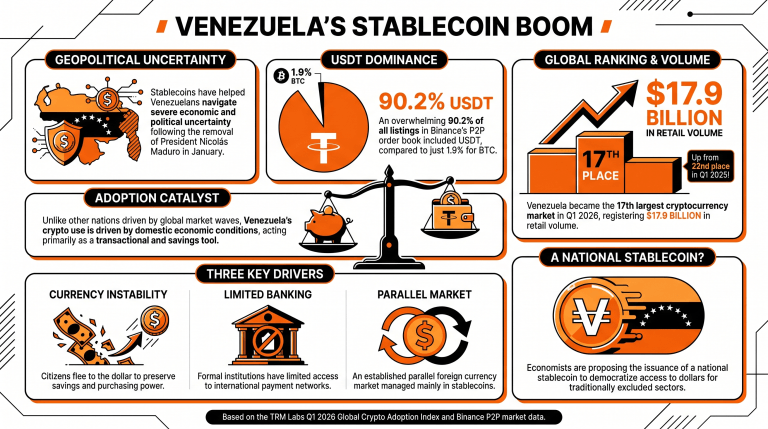
The report found that 90.2% of all listings in Binance’s P2P order book, which is currently the most popular P2P exchange in the country, included USDT, while only 1.9% included BTC paired with the local fiat currency, the Venezuelan bolivar.
This rise in stablecoin usage and popularity made Venezuela the 17th largest cryptocurrency market in Q1 2026, with $17.9 billion in retail volume. Venezuela ranked 22nd in Q1 2025.
The blockchain intelligence company attributes this growth to a difference in how use cases drive crypto’s growth in other nations. While other markets adopt crypto in waves linked to market conditions, Venezuela’s use case is “driven by domestic economic and political conditions, with stablecoins serving as the primary transactional and savings tool.”
The prevalence of stablecoins in the Venezuelan crypto economy can be explained by three factors: the currency instability that drives Venezuelans to flee to the dollar as a way of preserving their savings and purchasing power, the limited access that formal institutions, including the banking system, have to international payment networks, and the established parallel foreign currency market managed mainly in stablecoins.
Economists have even proposed issuing a national stablecoin as part of the solution to the country’s foreign currency issues, democratizing access to dollars for traditionally excluded sectors.