Key Takeaways
- Base mainnet block production stalled for nearly 2 hours on June 25 after block #47,806,542 caused a consensus failure.
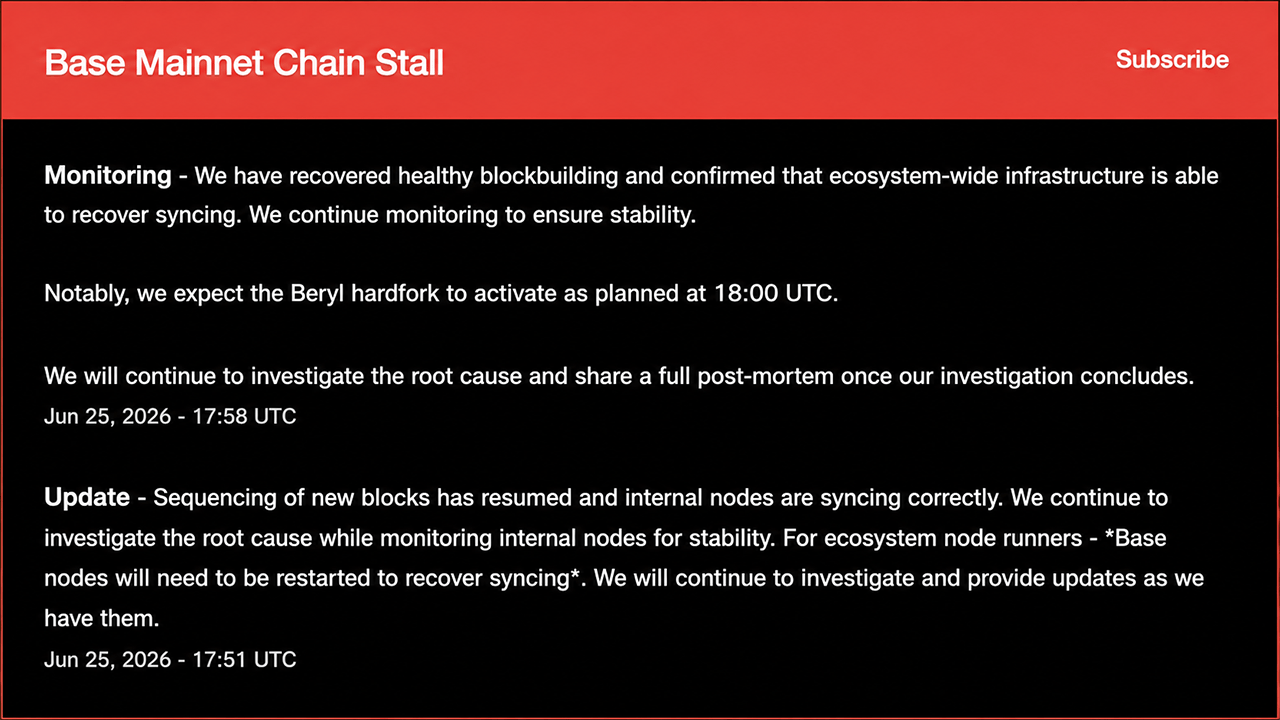
- Coinbase’s Base team confirmed all funds are safe, with sequencing restored by 17:51 UTC and monitoring ongoing.
- Base’s Beryl hard fork, introducing the B20 native token standard, remains on schedule for its 18:00 UTC activation window.
What Happened
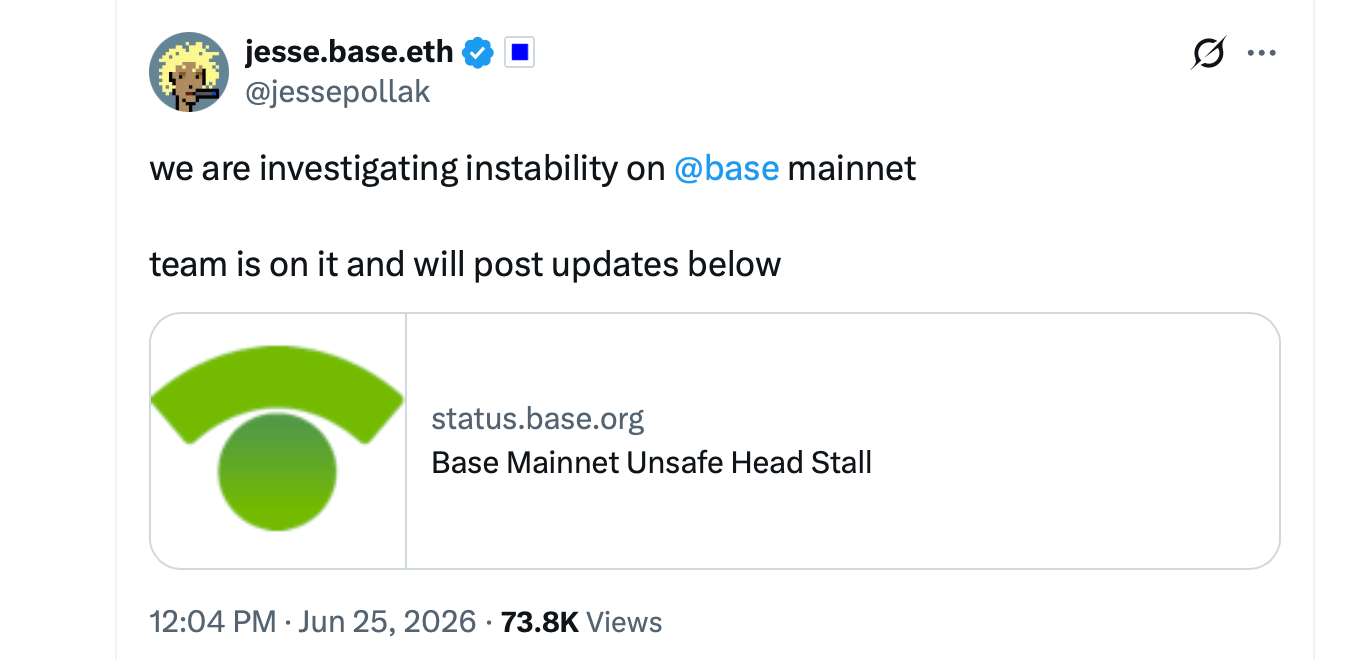
The incident began at 16:03 UTC on June 25, 2026, when Base engineers detected unhealthy block production on the network’s mainnet. By 16:52 UTC, the team had identified the root cause: a consensus problem caused the sequencer to produce an invalid block, specifically block #47,806,542, which then interfered with all subsequent block building.
In OP Stack terminology, the event is classified as an “unsafe head stall.” That means the sequencer stopped advancing new blocks entirely. The unsafe head refers to the latest sequencer-produced blocks that have not yet been posted to Ethereum’s layer one (L1) for finalization.
Timeline:
- 16:03 UTC: Block production flagged as unhealthy; investigation begins.
- 16:52 UTC: Engineers identify block #47,806,542 as the problematic source.
- 17:21 UTC: Consensus issue isolated; internal sequencer and nodes show preliminary recovery.
- 17:51 UTC: Block sequencing resumes; internal nodes begin syncing correctly.
- 17:58 UTC: Blockbuilding confirmed healthy; network enters monitoring phase.
What It Means for Users
Deposits, withdrawals, and transactions on Base were delayed during the roughly two-hour stall. Node operators running Base infrastructure will need to restart their nodes to fully recover syncing.
Funds are not at risk. Unsafe head stalls occur before blocks are batched and submitted to Ethereum L1, so there is no exposure to permanent loss or meaningful chain reorganizations.
Beryl Upgrade Still on Track
The incident coincided with the scheduled Beryl hard fork, planned for an 18:00 UTC activation window on the same day. Base confirmed the stall is unrelated to the upgrade.
Beryl introduces B20, a native token standard built directly into node software rather than deployed as a smart contract, making token issuance more efficient for stablecoins and real-world asset projects. The upgrade also reduces withdrawal delays and ships Reth V2 improvements. Node operators must run base/ node v1.1.1 or later. Most users and existing contracts require no action.
What Comes Next
Base engineers are continuing to investigate the root cause of the invalid block and plan to publish a full post-mortem once the review concludes. The status page at status.base.org and block explorer basescan.org remain the primary monitoring resources.
Unsafe head stalls of this type have occurred previously on other layer two networks and Optimism mainnet, often tied to internal infrastructure conditions, L1 node issues, or load-related factors. This incident lasted roughly 115 minutes before sequencing resumed.