Key Takeaways
- Morgan Stanley overtook Goldman Sachs as the top AI debt-deal bank as global AI issuance nears $570B in 2026.
- Morgan Stanley CEO Ted Pick says 2026 data center capex is running near $850B, up from a $575B forecast.
- Morgan Stanley and JPMorgan are arranging roughly $13B for a Meta data center in El Paso, Texas.
A New Leader on Wall Street
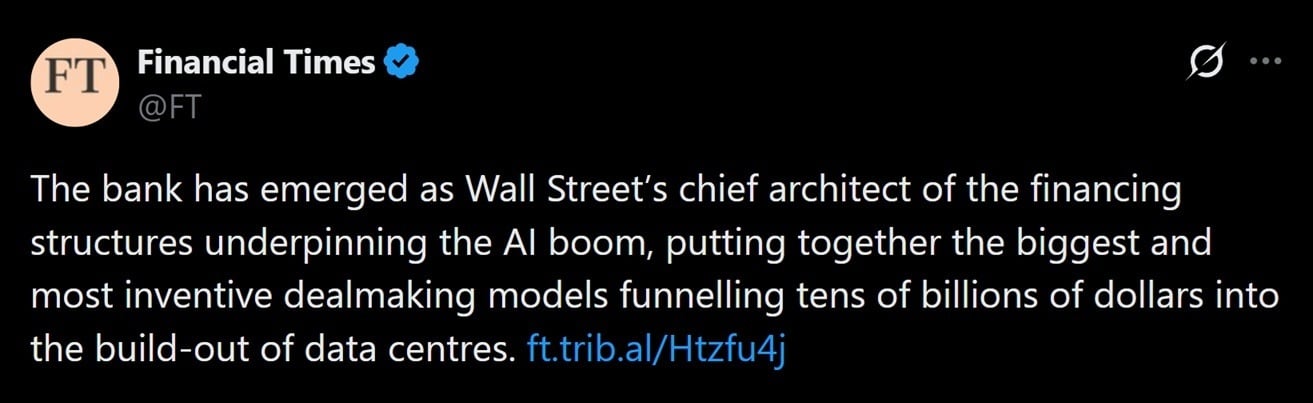
The shift is worth noting because debt underwriting has quietly become one of the most lucrative franchises tied to the artificial intelligence buildout, as hyperscalers and cloud providers borrow heavily to fund data centers rather than fund them purely with cash.
Morgan Stanley Chief Executive Officer Ted Pick has been vocal about the scale of that spending, stating that data center capital expenditure (initially forecast at $575 billion for 2026 back in November 2025) is now tracking closer to $850 billion, a jump of roughly 48% in eight months.
The bank’s growing footprint is already visible in specific deals, with Morgan Stanley and JPMorgan Chase recently announcing that they were working on a financing package of roughly $13 billion for a Meta Platforms data center in El Paso, Texas.
Where the Money Comes From
Global AI-related debt issuance is projected to reach $570 billion in 2026, according to Morgan Stanley’s own research, as companies have increasingly turned to leveraged finance, investment-grade bonds and structured credit to fund gigawatt-scale data centers.
Wells Fargo banking analyst Mike Mayo has pointed to Morgan Stanley, Goldman Sachs and JPMorgan as the three biggest beneficiaries of the trend, and Bank of America has separately helped raise nearly $500 billion for AI-related companies since 2025.
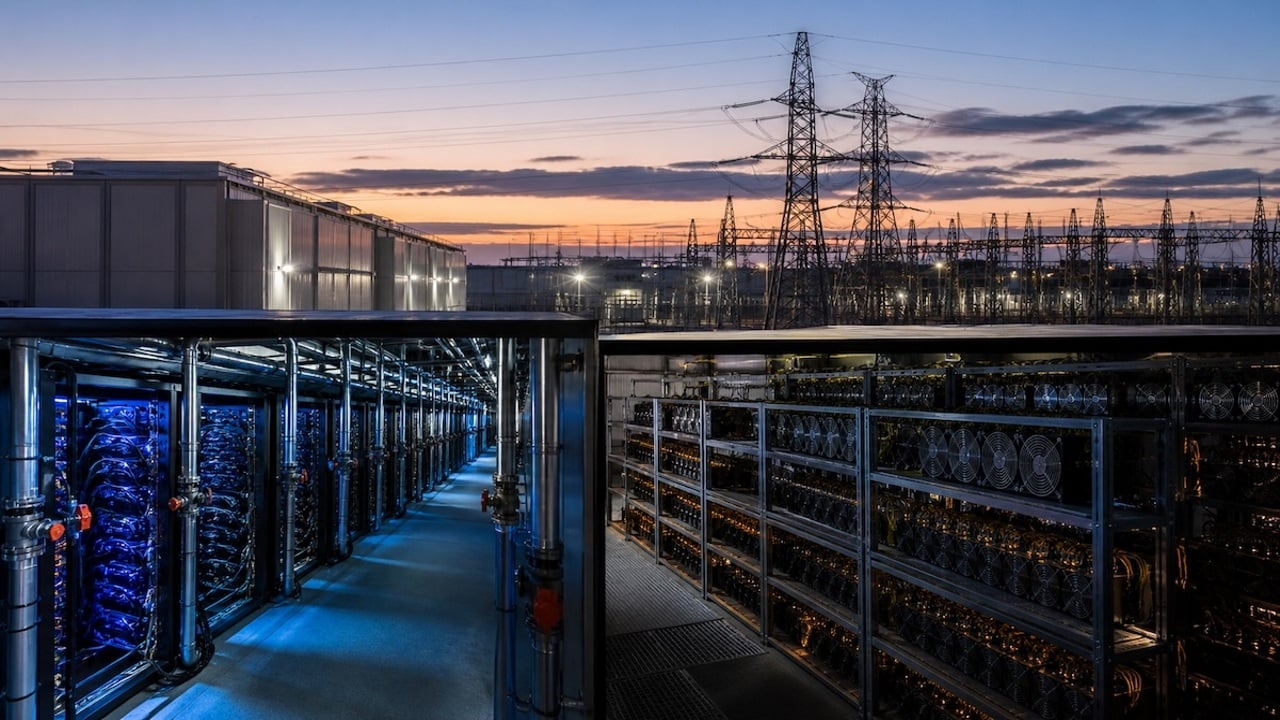
Bitcoin.com News has tracked the same financing wave reshaping crypto-adjacent mining companies. Morgan Stanley backed miner-turned-AI-infrastructure firm Core Scientific with up to $1 billion in financing for data center growth, a facility JPMorgan later expanded by another $500 million to bring the total to $1 billion.
Core Scientific’s pivot culminated in a roughly $9 billion all-stock acquisition by CoreWeave, with the combined companies planning to spend about $5.5 billion developing six data centers across five sites by the first half of 2027.
A Market Getting Nervous
Not every signal points to smooth sailing as bond investors have begun pushing back amidst AI-related debt heading toward $570 billion, with declining coverage ratios on hyperscaler bonds suggesting lenders may soon demand higher yields to compensate for the risk.
Goldman Sachs CEO David Solomon has described the environment as the middle of an “AI capex super cycle,” one where banks are deploying every financing instrument available (investment-grade debt, leveraged loans and equity capital markets alike).
That backdrop raises the stakes for whichever bank leads the league tables since winning the AI debt franchise now means also owning more exposure if hyperscaler spending outpaces the revenue it is meant to generate.
That said, Goldman Sachs is not conceding the AI financing race; instead, the bank is simply positioning itself alongside Morgan Stanley for upcoming AI-sector listings, including a possible Anthropic offering. It even co-led the Meta-adjacent CoreWeave-Core Scientific dealmaking alongside Morgan Stanley as a joint arranger on a separate $2.6 billion CoreWeave facility.