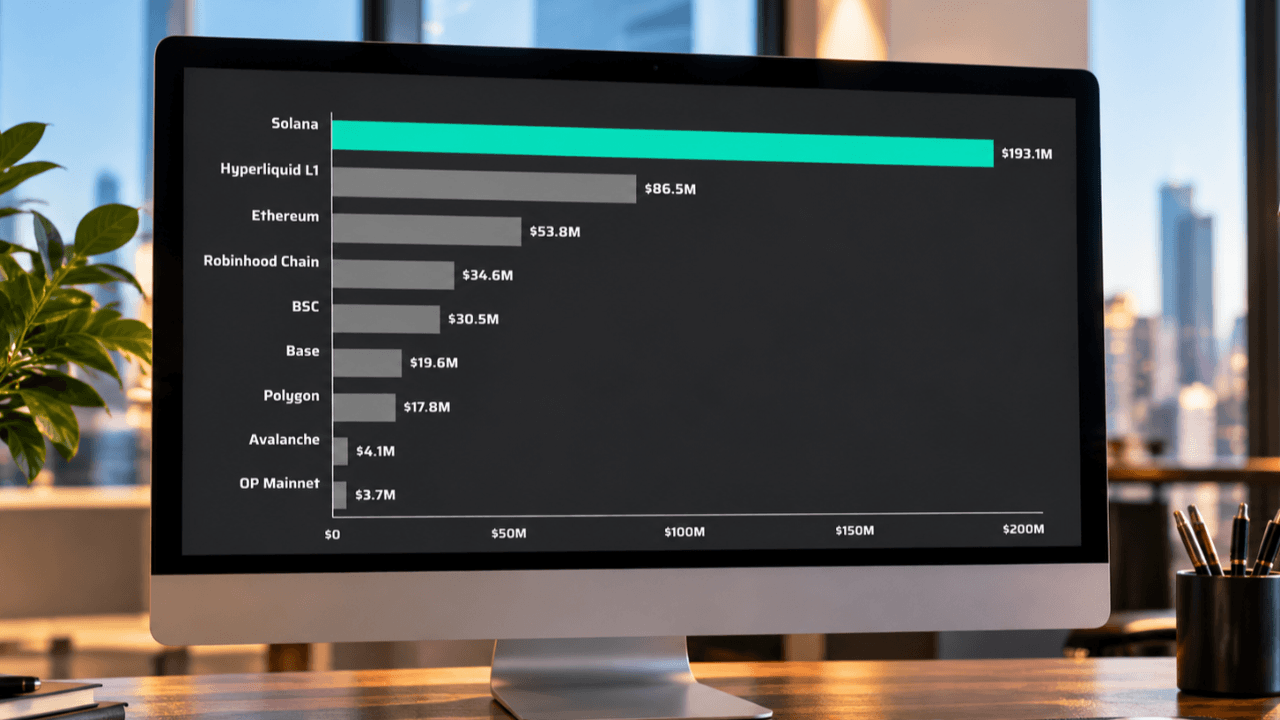
Key Takeaways
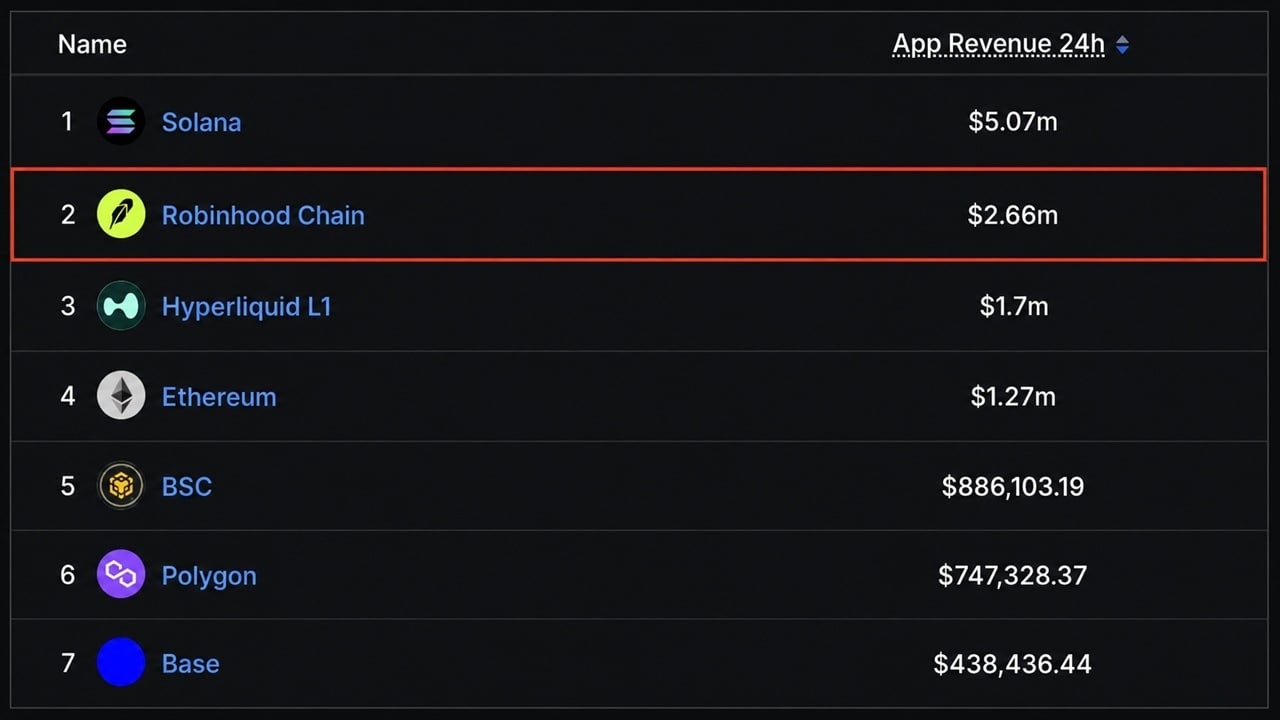
- Robinhood Chain’s apps generated $2.66 million in 24-hour revenue on August 30.
- Gmgn, Pons and Uniswap combined for about 88% of that revenue, per the same data.
- Hyperliquid still processed $8.9 billion in perpetuals volume in a single July day.
A Two-Month-Old Chain Punches Above Its Weight
Even though the Arbitrum-built L2 launched its public mainnet on July 1, during Robinhood’s “The World Is Flat” event in London, it is already beating far more established networks by at least one measure.
On August 31, application revenue on Robinhood Chain hit $2.66 million over 24 hours, putting it ahead of established industry mainstays like Hyperliquid L1’s $1.7 million and Ethereum’s $1.27 million on the same day, and nearly six times Base’s $438,436.
It is a narrow slice of a much bigger picture, but it is the kind of number that gets a young chain noticed. Robinhood Chain has made a habit of topping individual metrics since its launch, briefly leapfrogging Base and Ethereum in 24-hour DEX volume within its first two weeks, and by mid-August it had reportedly overtaken Ethereum in NFT trading volume as well.
Where the Money Actually Came From
App revenue is not an abstract measure, but the fees users actually paid to specific protocols. On Robinhood Chain, three apps did most of the work on August 30, namely:
- Gmgn, the onchain trading terminal popular with meme coin traders, pulled in roughly $1.11 million.
- Pons, a token-launch and social-trading platform, generated about $930,587.
- Uniswap, running its spot-trading business on the network, added another $306,877.
Combined, they accounted for close to 88% of everything the chain earned that day. That mix says something about who is actually using Robinhood Chain right now, given that the network was built around tokenized real-world assets, stock tokens and ETFs, with equity price feeds piped in through Chainlink oracles covering 95 tokenized stocks.
Hyperliquid Still Sets the Pace
It would be a mistake to read one good day of app revenue as Robinhood Chain dethroning Hyperliquid because a quick zoom out of the macros shows that the latter is still the top dog in this arena.
Last month on the 13th, Hyperliquid processed $8.9 billion in perpetual futures volume in a single day, compared with just $5.9 million on Robinhood Chain the same day. Not only that, but Hyperliquid has also captured an estimated 9% of the world’s perpetual contract open positions, something its rivals can’t hold a candle to at the moment.
That said, app revenue and trading volume measure different things, and Robinhood Chain’s edge in the former does not cancel out Hyperliquid’s dominance in the latter. What the August 30 numbers do, however, suggest is that Robinhood is successfully routing a meaningful slice of retail trading activity, much of it from its own brokerage user base, onto its own chain, generating fees that would otherwise flow to Ethereum or Base instead.
Lastly, it bears mentioning that the latest numbers land at a time when bitcoin’s price has continued to hover near $78,000, with the wider crypto market largely treading lightly too.